
Why AWS Asks You to Choose a Region Every Time You Deploy
The cloud isn’t floating in the sky it lives in real buildings across the world.

Where does the internet live ?
You open YouTube. A video loads in two seconds.
Simple, right?
But somewhere between you hitting play and the video appearing, your request left your phone, traveled through your WiFi, shot across a network of cables, arrived at a building on the other side of the world, got processed by a computer there, and came racing back to your screen.
That building is a data center. And it's the most important piece of infrastructure most people never think about.
What actually is a data center?
Forget "the cloud" for a second. Behind it all are real computers running in real buildings.
A data center is a loud, cold and heavily secured warehouse packed with computers.
When you upload a photo, stream a video, open Gmail, or deploy an app - somewhere, a physical computer is handling that request.
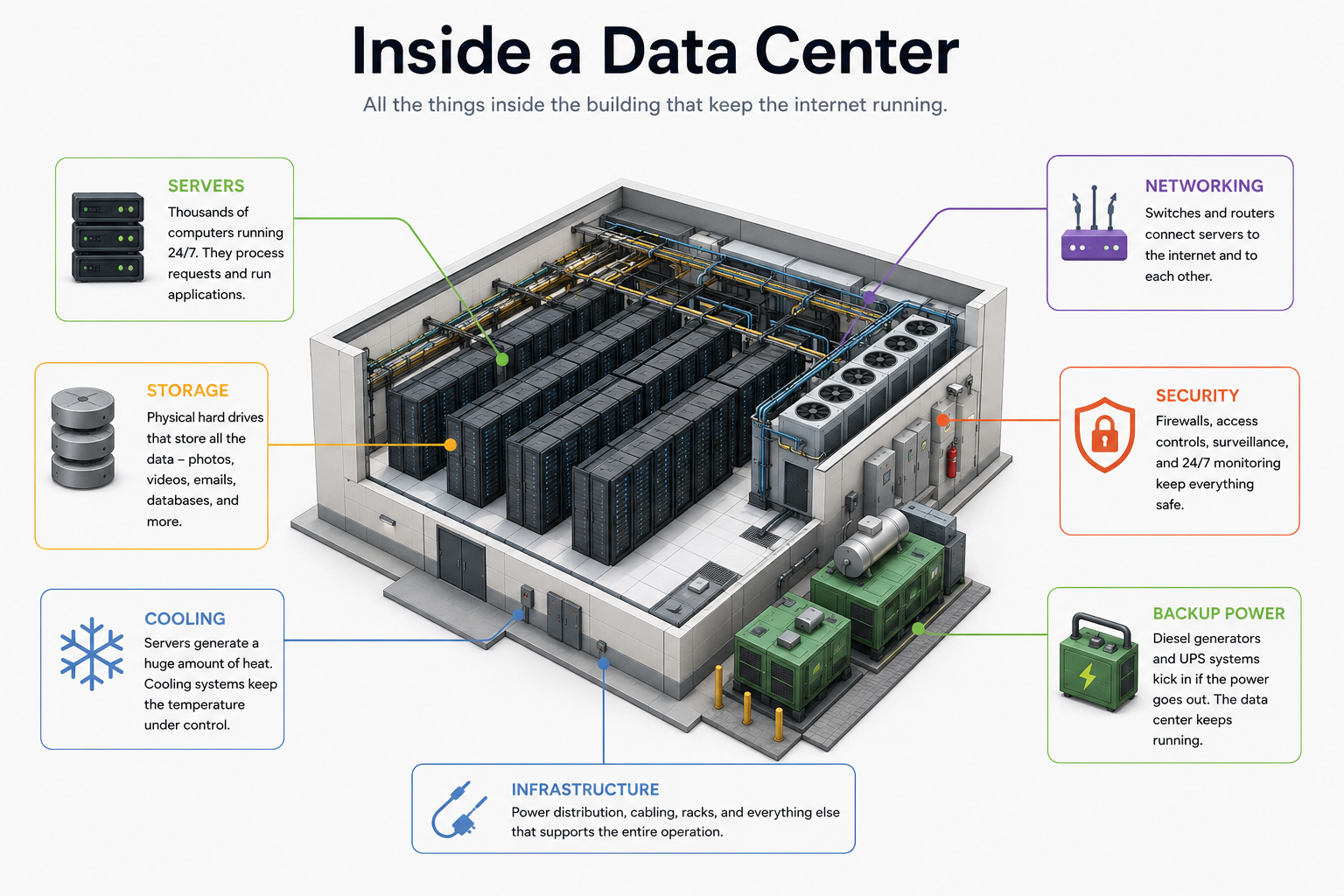
These buildings cost hundreds of millions of dollars to build and maintain. Every major tech company has them - Google, Meta, Microsoft, Amazon.
And then there’s AWS.
Why Does AWS Call Its Data Centers "Regions"
AWS has huge data centers in different parts of the world - the US, Europe, Asia, the Middle East, and more.
Instead of treating every building separately, AWS groups nearby data centers together. That group is called a region.
So when you see something like ap-south-1 on AWS, it’s not just a random name. It refers to AWS infrastructure located in Mumbai, India.
us-east-1 is in Northern Virginia.eu-west-1 is in Ireland.ap-southeast-1 is in Singapore.
Every AWS region is an actual physical location with real buildings and real servers running inside them.
What AWS Region Names Actually Mean
Once you realize AWS regions are actual places, the naming starts making sense.
The format is basically:
location + direction + number
us-east-1       → Virginia
us-west-2       → Oregon
eu-west-1       → Ireland
eu-west-2       → London
ap-south-1      → Mumbai
ap-southeast-1  → Singapore
ap-northeast-1  → Tokyo
me-south-1      → Bahrain
The last number is mostly just the order AWS created them in.
So us-east-1 was the first AWS region ever.eu-west-2 came after eu-west-1.
What Happens Inside a Region
A single AWS region isn’t just one building. It’s made up of multiple separate data centers spread across the same area. AWS calls these Availability Zones (AZs).
For example, the Mumbai region (ap-south-1) has multiple zones like:
ap-south-1aap-south-1bap-south-1c
These are separate facilities with their own power, cooling, and networking.
So if one building has an issue, the others can still keep things running. That’s why apps like Swiggy, Netflix, or banking apps usually don’t completely go offline.
An easy way to think about it:
Region              → a city (Mumbai)
Availability Zone   → a building in that city
Data Center         → the actual server warehouse
Understanding Regions Through S3
S3 (Simple Storage Service) is AWS's storage product.
A bucket is basically like a folder, except it lives on AWS and can be accessed over the internet with the right permissions.
When you create a bucket, AWS asks you one thing first:
Create bucket
Bucket name: my-app-uploads

AWS Region:
● Asia Pacific (Mumbai)        ap-south-1
○ US East (N. Virginia)        us-east-1
○ Europe (Ireland)             eu-west-1
○ Asia Pacific (Singapore)     ap-southeast-1
This is asking: which city do you want your files to physically live in?
And that choice matters more than most people realise.
Why the region you choose matters?
The AWS region you pick actually affects a few important things.
Speed: If your users are in India, keeping your app or files in ap-south-1 (Mumbai) will usually feel much faster than storing everything in the US.
Data rules: Some countries have rules about where user data should be stored.
Cost: AWS regions also have different pricing. Some are cheaper than others.
One important thing: after creating an S3 bucket, you can’t directly change its region later.
You’d have to create a new bucket and move everything yourself.
So that region dropdown on AWS is actually worth thinking about for a few seconds.
Every major cloud company is expanding heavily in India right now. More data centers are being built in cities like Mumbai, Hyderabad, and Chennai.
At the same time, rules around where user data should be stored are becoming more important too.
So for developers building apps in India, ap-south-1 is slowly becoming the obvious choice - not just because it’s faster, but because keeping Indian user data in India is starting to matter more.
So the next time AWS asks you to pick a region, remember there’s an actual building behind that dropdown.
The cloud was never really a cloud.
— AbhignaConsole Diaries — a developer’s notes
Connect with me on LinkedIn: a6h1gna


